Rethinking Cardiac Remote Monitoring Workflow in a Small but Growing Device Clinic
Published by
PaceMate
on
Most conversations about cardiac remote monitoring focus on the transmission. A device sends data, a system receives it, a clinician reviews it and creates a report of the findings. That framing is accurate, but it describes only a fraction of the work a device team actually performs.
The rest of the work is coordination. Logging into separate vendor portals. Re-entering findings across systems. Ensuring physician review and signature. Manually entering charges in the EMR. Troubleshooting monitor connection with patients over the phone. None of this work is clinical decision-making, and all of it consumes the hours of the person best positioned to do clinical work. At Freeman Health Cardiology, that person is Practice Manager Demi Thompson, RMA, CET, who oversees device management, patient data, and billing workflows across two Arkansas locations.
Device Clinic Resources Have Not Kept Pace with CIED Volume
Freeman's situation is not unusual. Cardiac implantable electronic device (CIED) populations continue to grow, patients are living longer with their devices, and professional society guidance supports remote monitoring for every eligible patient. Enrollment has scaled accordingly. Device clinic staffing has not.The result is a familiar arithmetic problem. A device clinic inherits a larger population every year, receives more data from that population, and absorbs the administrative work each transmission generates. Every added step in the device clinic workflow is multiplied across the entire panel, and the smaller the team, the more visible that multiplication becomes.This is where most cardiac remote monitoring technologies reveal what they were designed to do. A system built around receiving transmissions will deliver transmissions. It will not indicate which of today's transmissions need priority attention, reconcile them with the electronic medical record (EMR), or carry them into a billable encounter. Connectivity is part of the same gap. A monitor that has quietly stopped transmitting leaves a patient functionally unmonitored. In many clinics, the responsibility of reconnecting a patient to their remote monitor is the same clinician already working the remote monitoring queue.
Triage Should Start with the Patient, Not the Transmission
Alert severity and clinical risk are not the same thing, and most triage is built on the first one.Every manufacturer flags alerts. What is missing is context. A vendor portal ranks what the device reported. It has no view of the chart, so it cannot account for the patient's medical history. A red alert on a stable patient with no comorbidities and a yellow alert on someone recently discharged after a heart failure admission carry identical weight to a system that only knows the transmission.Fragmentation compounds the problem. Each vendor applies its own categories, thresholds, and terminology inside its own portal, so a technician covering a multi-vendor population starts the day with several prioritized lists with varying definitions of what is "urgent". Reconciling them into one working order of operations is invisible work that happens every morning.Auto-Triage™, exclusive to PaceMate, inverts that. Customizable algorithms combine device alerts with real-time EMR data integration to prioritize the most vulnerable patients first, which means the queue is ordered by clinical risk rather than by alert severity alone.
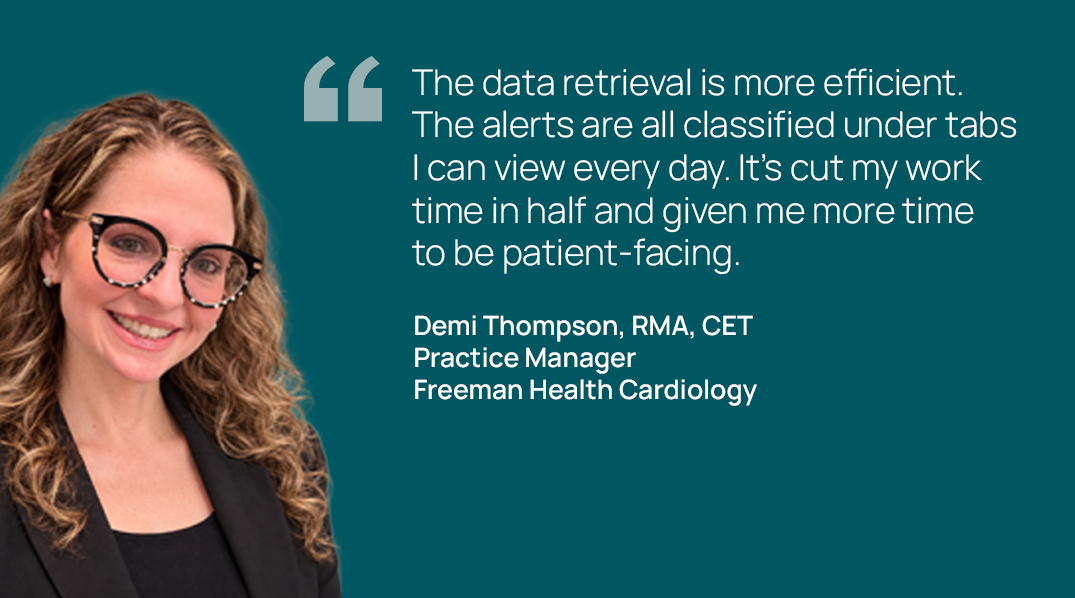
"The data retrieval is more efficient. The alerts are all classified under tabs I can view every day. It's cut my work time in half and given me more time to be patient-facing." Demi Thompson, RMA, CET
That last clause is the outcome worth holding onto. Time recovered from navigation and data entry does not disappear into the calendar. In a single-technician clinic, it returns directly to patients.
Remote Monitoring Reimbursement You Can Trust
Remote monitoring reimbursement depends on a documentation chain that has to hold together across several systems and several people. A transmission is reviewed, a report generated, a physician interprets the findings and signs, the record is filed, and a charge is captured. Underneath all of it sits the global billing period, which determines whether a given encounter is billable at all. Every handoff in that chain is a point where visibility can be lost, even when the clinical work is complete and correct.Freeman Cardiology's previous process relied on manual handoffs at each of those points. Signed transmissions were faxed or emailed to billing separately from the clinical record. Some moved through as expected. Others required follow-up and reconciliation, which is the routine cost of running a workflow across systems that do not communicate with one another.PaceMate tracks the global billing period for every patient and drops charges only for those remote monitoring encounters that fall within a billable window. Billable encounters are captured rather than missed; encounters that are not billable are never submitted. The result is a charge file that reflects the work actually performed and eligible for reimbursement, without the manual reconciliation that used to sit between the clinic and billing.
"It's made billing integration much cleaner, and we're now able to accurately track revenue." Demi Thompson, RMA, CET
The change is less about billing software than about where the data lives. With bidirectional EMR integration, the clinical record and the billable event are produced by the same workflow rather than as a separate task.
Support Is Part of the Partnership
Implementation is often when device clinics are asked to carry the greatest operational risk. What happens after go-live is what ultimately determines whether a new technology becomes a long-term success.At Freeman Cardiology, that support has been a key part of the experience. Demi works closely with Earl, her PaceMate Strategic Account Executive, and Sean, her PaceMate Customer Success Manager. Together, they provide both day-to-day guidance and long-term strategic support as the clinic's needs evolve.
"Earl came in person to do my training because I wasn't getting what I needed virtually," she said. "Sean has been there for every EMR issue we've run into. This partnership made what could have been a difficult rollout genuinely smooth."
"I especially love the backup support. If I have any issues, I can call Earl, I can call Sean," she said.
The same commitment extends to patients. Monitor troubleshooting and missed transmissions once generated a steady stream of inbound and outbound calls that landed on Demi's desk. Today, PaceMate's Patient Services team proactively helps patients stay connected, reducing the burden on clinic staff while helping ensure continuity of care.
"My patients can call and get their monitors connected again. They used to call me. It's cut my call times in half," she said.
What This Makes Possible for a Growing Device Clinic
Manual steps were removed from the workflow, allowing the device population to grow without the administrative burden increasing at the same rate. Automation is the difference between growth a clinic can plan for and growth it has to absorb.
"This partnership lets a clinic like ours operate confidently and keep growing, on our own terms," Demi said.
Asked to summarize the transition, she was direct.
"It's a genuinely strong platform with a team behind it that actually shows up. I'd recommend it without hesitation."
PaceMate extends device clinic capacity through technology, patient support, integration expertise, and clinical services, helping teams spend less time managing workflows and more time caring for patients.
Share in


