The Bottleneck Isn’t Accuracy. It’s Trust.
Published by
Sean Shoffstall
on
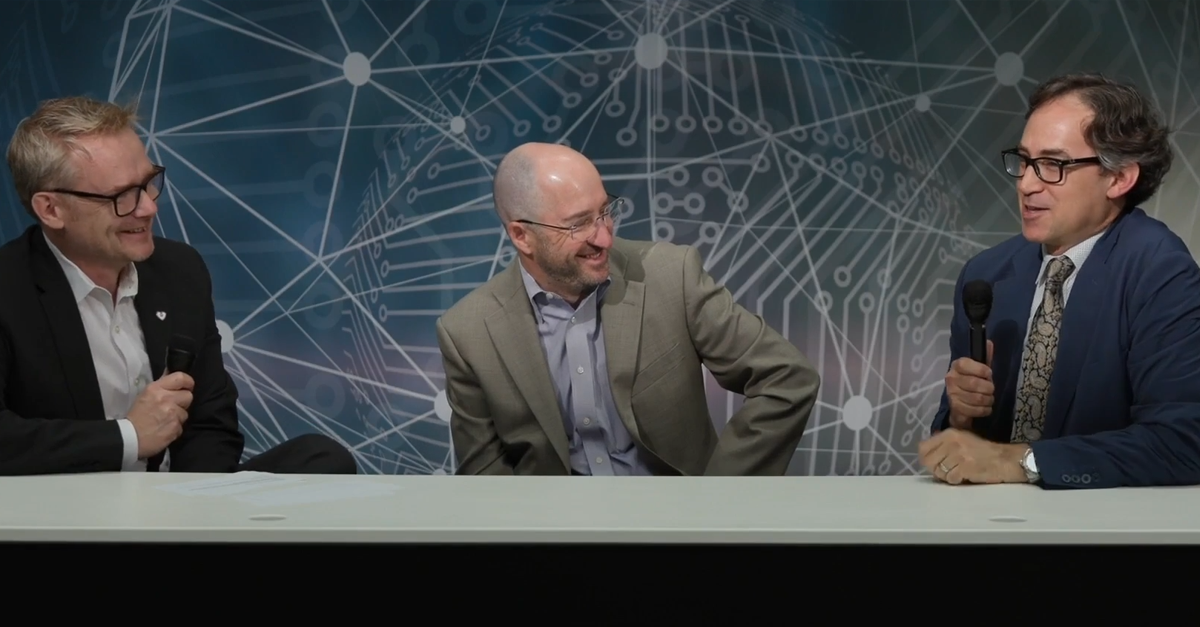
At HRS2026, top EP physicians tackled the AI question: "Are we using AI to improve outcomes, or just gaining efficiencies? In Part 2 of this three-part series, Sean Shoffstall shares more of the discussion.
At our HRS2026 panel in Chicago, sitting between Dr. Ben Steinberg of Denver Health and the University of Colorado and Dr. Jonathan Piccini of Duke, I watched the conversation keep circling back to a word that doesn’t appear on most AI pitch decks. Not accuracy. Not efficiency. Trust.
The industry has trained itself to answer almost every hard question about AI with a number — higher sensitivity, better discrimination, a more impressive area under the curve. Those numbers matter, and I won’t pretend otherwise. But the single most important insight from our hour together had nothing to do with model performance, and everything to do with whether the humans on either end of the tool believe in it.
The self-driving car problem
Dr. Steinberg framed it with an analogy I’ve thought about every day since. Consider self-driving cars. The data may eventually show — may already show — meaningful reductions in accidents. And yet there remains an intense, durable trust problem around the accidents that are caused by the autonomous system. We extend a grace to human error that we simply refuse to extend to machine error, even when the machine is, on balance, safer. The asymmetry isn’t rational in a pure statistics sense, but it is deeply human, and it is real.
Healthcare, he argued, behaves the same way. The data are the data. But the adoption of any clinical AI tool starts with trust on the part of the physician and ends with trust on the part of the patient. That sentence has stayed with me because of its structure — it has two ends, and both have to hold.
Trust is two-sided, and we keep forgetting one side
Most of the trust conversation in our industry focuses on the front end: will the physician believe the output? That matters enormously. A clinician who doesn’t trust a recommendation will, correctly, override or ignore it, and your beautifully accurate model becomes shelf-ware.
But Dr. Steinberg’s framing insists on the back end too. Even when the physician trusts the tool, the patient has to trust the physician who used it. If a patient senses that a consequential decision was outsourced to a system they don’t understand and didn’t consent to, the trust breaks on the far side of the bridge — and the clinical relationship, which is itself therapeutic, takes the damage. A tool can be accurate and still corrode the thing that makes medicine work. That’s why accuracy was always necessary but never sufficient. It gets you onto the bridge. It does not get you across.
The hidden trust cost of building AI to subtract
Here’s where I want to make an argument that I think the industry has mostly avoided, because it cuts against how a lot of cardiac AI is actually built.
A great deal of the AI in our space is designed to subtract. Its core promise is to filter, suppress, and shrink — to make the data deluge smaller so the clinician sees less of it. And on the surface, given the genuine problem of alert burden, that sounds like exactly what a stretched device clinic wants. Less noise. Fewer transmissions. A quieter inbox.
But look closely at what a subtracting tool actually asks you to trust. It asks you to trust a disappearance. Something arrived, the model decided it didn’t matter, and it removed it before you ever saw it. The efficiency is real — but it’s purchased with an act of faith, because you cannot evaluate what you were never shown. You’re trusting that the algorithm’s judgment about what’s irrelevant matches yours, in a population it may or may not have been validated on, on a day when the patient in question may or may not resemble its training data.
This is precisely the machine decision Dr. Steinberg’s self-driving analogy warns about. As long as the suppression is always right, trust holds and even grows. But the first time a subtracting tool filters out the transmission that mattered — the early sign, the subtle change, the one a tired human might still have caught — the trust doesn’t just dip. It collapses, and it collapses in the same asymmetric, unforgiving way we react to a self-driving crash. You don’t get the credit for the thousand correct suppressions. You get the blame for the one that wasn’t.
Trust scales with stakes, not with accuracy
The most strategically important thing either physician said came from Dr. Piccini, and it reframes the whole deployment question. Trust, he observed, doesn’t scale with accuracy. It scales with stakes.
Look at where AI has earned trust so far. The operational tools — directing faxes, handling refills, triaging incoming data — were adopted readily, and that trust has been rewarded. But that’s the easy end of the ladder. As AI begins to articulate the treatment plan, the required trust climbs. And as those tools creep toward interventional procedures — toward the moment a recommendation touches a catheter — the bar rises higher still. That, he said, is the important next step in the evolution, and the one where trust will be hardest to earn.
The implication the industry hasn’t absorbed: you do not climb that ladder by subtracting more aggressively. Making more decisions on the clinician’s behalf — suppressing more, filtering harder — moves you up the stakes ladder while doing nothing to earn the trust that higher rung demands. You’re taking on more consequential decisions precisely as you’re hiding more of your reasoning. That’s backwards.
Additive intelligence: the posture that earns trust
This is the distinction I care about most, because it separates AI that earns trust from AI that spends it.
There is a meaningful and underappreciated difference between AI that helps a physician make a better decision and AI that makes the decision for the physician. Subtractive AI drifts, almost by gravity, toward the second — every alert it silently suppresses is a small clinical decision it made instead of you. The alternative is what I’d call additive intelligence: AI that shows up wherever there’s data and makes that data mean more, while leaving every decision exactly where it belongs.
The difference is directional. A subtracting tool’s instinct is to show you less — to reduce the field of view until only what it deemed important remains. An additive tool’s instinct is the opposite: to surface the trend across ninety days that a single transmission would never reveal, to connect the pattern across a population, to let you ask a question of the record and get a straight answer — and then to hand all of that back to you so you decide what it means. One makes data disappear. The other makes data make sense. And only one of those is something a clinician can actually trust, because only one of them is willing to show its work.
This is the philosophy we build around at PaceMate, and I’ll be candid that it isn’t a marketing posture — it’s a practical necessity. We learned, as everyone in this space eventually does, that a tool clinicians cannot interrogate is a tool clinicians will not adopt, regardless of how strong its numbers look on a slide. Additive intelligence is auditable almost by definition: its entire job is to put more understanding in front of you, not to make choices behind you.
Why the skepticism is good medicine
A recent review of artificial intelligence in cardiology made the underlying point without hedging: while these tools show real promise, many algorithms perform well in controlled settings but require external validation across diverse patient populations before they can be relied on in the real world. The same body of work flags the persistent problem of algorithmic bias, where training data that overrepresents some groups and underrepresents others produces disparities in AI-guided decisions.
So when a clinician hears “trust us, it’s 99% accurate” and immediately asks “in whom, and validated where?” — that isn’t resistance to progress. That is good medicine doing exactly what it’s supposed to do. And notice which kind of tool can actually answer the question. A subtracting tool struggles, because its work is hidden by design; the whole value proposition is that you don’t see what it did. An additive tool can answer, because showing you more is the entire point. The architecture that makes a tool trustworthy and the architecture that makes it additive turn out to be the same architecture.
Trust is the product
So here’s the reframe I’d leave you with. We tend to treat trust as a byproduct — something that accumulates downstream, after a tool proves itself on accuracy. I’ve come to believe it’s the reverse. Trust is the product. Accuracy is just one input, and the fastest way to squander it is to build AI that asks clinicians to accept what they can’t see.
The vendors who win electrophysiology over the next decade will not be the ones who help you see less. They’ll be the ones who help you understand more — who put intelligence everywhere your data already lives, and who keep every decision firmly in your hands while they do it. That’s the bar. Everything else is a demo.
Accuracy gets you into the room. Trust is what lets you stay. And trust, it turns out, is additive — never subtractive.
Stay tuned for the final part of this three-part series.
Watch the full HRS-TV panel with Dr. Steinberg and Dr. Piccini
Share in


