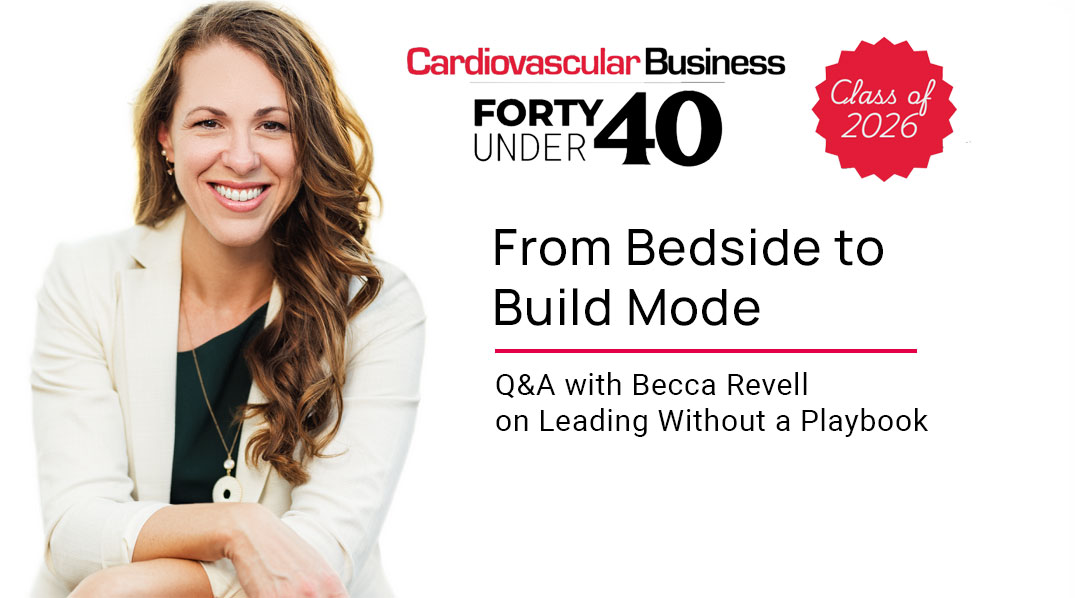
From Bedside to Build Mode: Becca Revell on Leading Without a Playbook
Published by
PaceMate
on
We sat down with Becca Revell, PaceMate's Senior Director of Patient Services, after Cardiovascular Business named her to their Forty Under 40 for 2026. A registered nurse certified as a cardiac device specialist, a distinction earned through more than a decade of cardiovascular and electrophysiology practice, she joined PaceMate in 2018 and built the patient services department from the ground up.
Q1: For people who don't know the Cardiovascular Business Forty Under 40, what is it, and what did it mean to you to be named to the Class of 2026?
Honestly, I wasn't familiar with it before this. Cardiovascular Business covers the field broadly — clinicians, researchers, health system leaders — and the recognition spans all of it. I was nominated by someone I consider a mentor, colleague, and friend, so I think what it really reflects is the work the team has built together here. I'm proud of what we've created, and if the award draws any attention to what's possible in remote cardiac monitoring, that's the part that matters to me.
Q2: You've built an entire department, you're certified as a cardiac device specialist, and you've spent over a decade in this field. What would you tell a woman early in her career in cardiovascular care who feels like leadership isn't meant for her?
Find the problem nobody's solving and start solving it. I didn't set out to lead a department — I saw gaps in how patients were being supported remotely and started building toward something better. I saw a gap in how knowledge is transferred to other team members and I built a learning management platform. The leadership came from the work, not the other way around – and suddenly as a leader your influence extends well beyond a single patient.
Q3: PaceMate's whole mission is making sure patients with cardiac devices never fall through the cracks. How does your clinical background shape how you approach that work?
It keeps me honest about what the stakes actually are. In a device clinic, you never forget that behind every alert is a person waiting to hear if they're okay. When I'm evaluating a workflow or a process gap, I'm always asking: if this fails, what happens to the patient? That's not something you can learn from a spreadsheet. You learn it looking a patient or caregiver in the eye and sharing in those vulnerable moments with them. That’s something you don’t forget. It shapes how I train my team, how I think about automation, how I define what "good" looks like operationally.
Q4: You joined PaceMate in 2018 and built the patient services department from the ground up. What did that process teach you about leadership that you couldn't have learned any other way?
There was no playbook. I came from an old-school clinical practice, where the protocols exist and the roles are defined. Building from scratch meant writing the playbook while also doing the work: hiring the first people, determining the processes, building training from nothing, figuring out what good looked like before we had enough history to measure it. What it taught me is that leadership at that stage is less about having answers and more about being involved in the work and in the people. Your team feels your steady presence before they read your plan. That's something you only learn by being in it.
Share in


