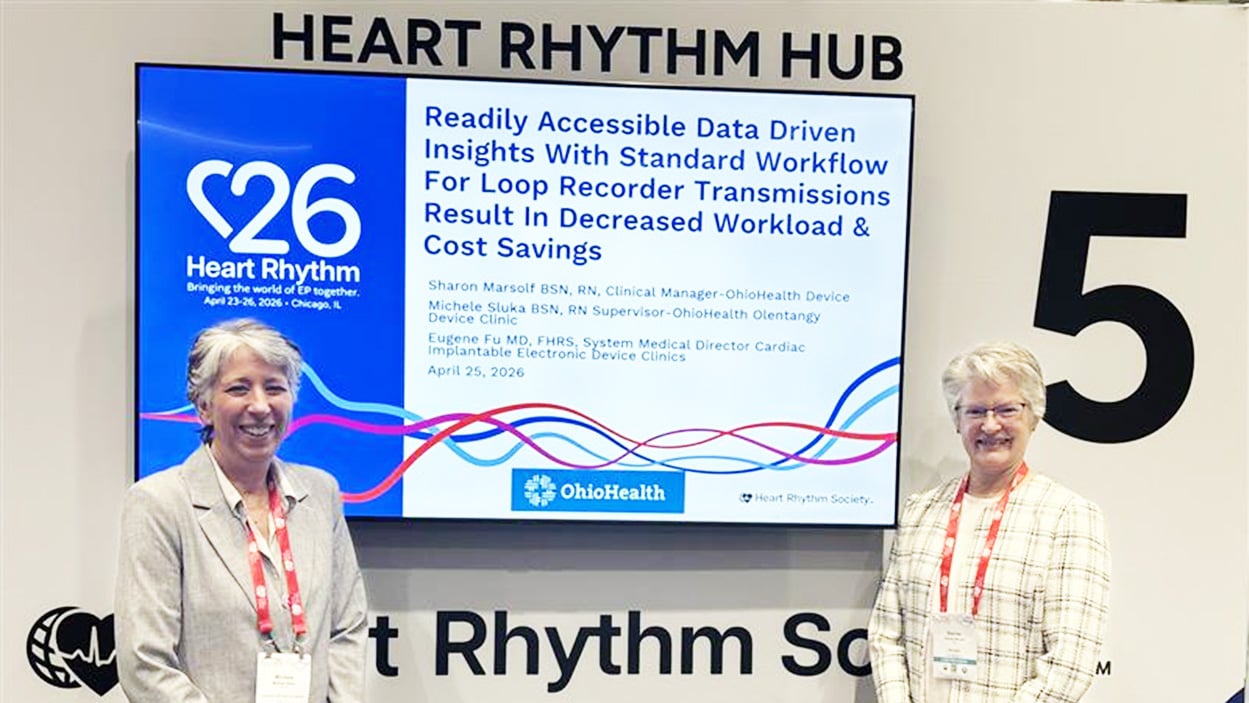
OhioHealth Heart & Vascular at HRS Scientific Sessions 2026
Published by
PaceMate
on
We are pleased to recognize the work of our partners at OhioHealth Heart & Vascular, presented at this year’s Heart Rhythm Society Scientific Sessions.
Sharon Marsolf, BSN, RN, Michele Sluka, BSN, RN, and Eugene Fu, MD, FHRS presented three abstracts addressing one of remote monitoring's most persistent challenges: the high volume of non-actionable ILR transmissions contributing to alert fatigue and unsustainable clinical workload.
Key findings across three studies:
-
System-wide Impact : https://www.heartrhythmjournal.com/article/S1547-5271(26)00595-3/fulltext
Using PaceMate® embedded analytics to identify the top 25 highest-transmitting patients over 90-day intervals, the team achieved an 18.2% cumulative reduction in non-actionable alerts, 345 fewer transmissions with 97.3% of interventions delivered remotely. Reductions in bradycardia (86.3%) and SVT (65.8%) alerts confirm the efficacy of targeted, data-driven programming.
-
Patient-level Results: https://www.heartrhythmjournal.com/article/S1547-5271(26)00949-5/fulltext
Focusing on the top 26 utilizers over five consecutive months, the team demonstrated a 71% reduction in avoidable transmissions (mean monthly transmissions: 71.3 down to 20.8, p<0.001, Cohen's d=3.28), with improvements sustained across successive months. Individual patients achieved >95% reductions. These findings support the conclusion that the majority of ILR transmissions can be safely minimized through systematic, patient-level optimization.
-
Real ROI: https://www.heartrhythmjournal.com/article/S1547-5271(26)00367-X/fulltext
Beyond clinical outcomes, these results carry measurable operational value. The analysis quantified 45.8 staff hours saved in a single quarter, projecting 183 hours, 0.09 FTE, and $9,168 in annualized cost savings from transmission reduction alone, while preserving every clinically relevant event.
The Takeaway
Default vendor alert algorithms are not sufficient. Structured workflows paired with accessible analytics yield sustained, measurable improvement across all device vendors.
The entirety of this analytical work, from process insight to outcome measurement, was conducted within the PaceMate platform, integrated into existing clinical workflows without supplementary tools or manual data extraction.
We congratulate the investigators: Sharon Marsolf, BSN, RN, Michele Sluka, BSN, RN, and Dr. Eugene Fu, FHRS. We thank the entire OhioHealth Heart & Vascular team for their continued collaboration and clinical leadership in advancing the field of remote monitoring.
Share in


